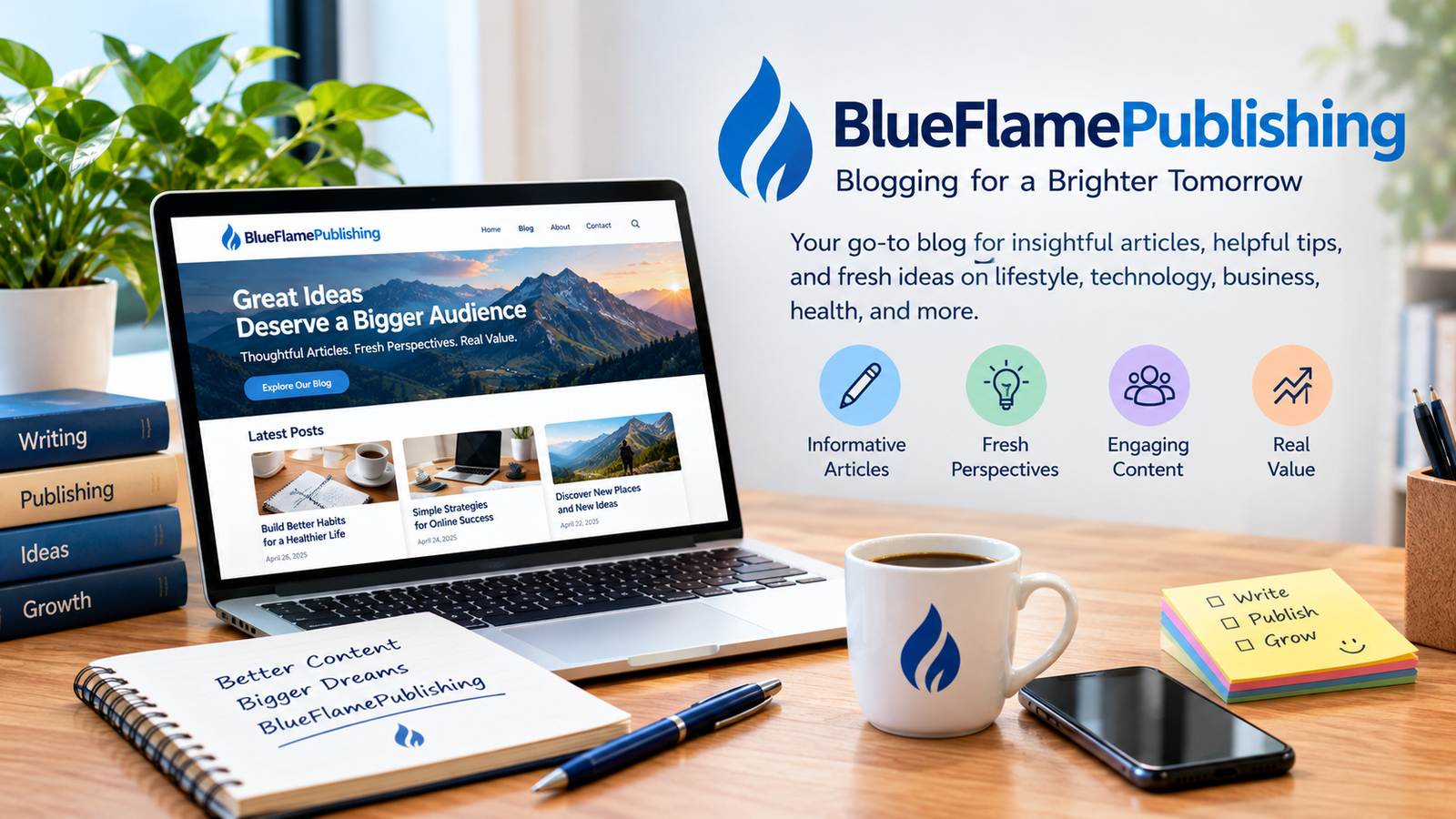
In Blog BlueFlamePublishing digital world, blogs have become an important way to share knowledge, build an audience, and communicate ideas with people around the globe. From personal experiences and educational guides to business insights and creative storytelling, blogs give writers a flexible platform to publish content and connect with readers. As digital publishing continues to grow, readers and creators are increasingly interested in platforms and websites that make online content easier to discover and understand. This is where the keyword Blog BlueFlamePublishing becomes an interesting topic to explore.
BlueFlamePublishing, as a publishing-related name, suggests a connection with written content, digital communication, and the process of sharing ideas online. However, the exact services, ownership, and features associated with a website using this name should be confirmed through its official information. Rather than assuming specific functions, it is useful to examine the broader publishing concepts that readers may associate with the keyword and understand what makes a blog valuable in the modern internet landscape.
This article explores Blog BlueFlamePublishing from a practical perspective. It discusses the purpose of publishing blogs, the importance of useful content, possible benefits for readers and writers, search engine optimization, content quality, and the factors to consider when evaluating a publishing website. Whether you discovered this keyword while researching online platforms or are interested in starting a blog of your own, this guide will help you understand the subject more clearly.
What Is Blog BlueFlamePublishing?
The phrase Blog BlueFlamePublishing combines two ideas: blogging and publishing. Blogging refers to creating and sharing articles online, while publishing involves making written material available to an audience. Together, these concepts describe a digital content environment in which information can be organized into articles and presented for readers to explore. The keyword may refer to a blog associated with BlueFlamePublishing, but its precise meaning depends on the website or service being discussed.
A publishing blog can serve many different purposes. Some blogs focus on educational information, while others cover entertainment, lifestyle, technology, business, literature, or personal development. The central goal is usually to provide material that answers questions, explains subjects, shares opinions, or encourages readers to explore new ideas. The most useful blogs maintain a clear purpose so visitors can understand what kind of information they are likely to find.
When researching Blog BlueFlamePublishing specifically, readers should distinguish between the meaning suggested by its name and the features that can actually be verified. A name alone does not establish whether a website publishes original articles, accepts guest posts, sells publishing services, or provides resources for authors. Checking its official pages, editorial information, contact details, and published content is the best way to establish what it offers.
The Role of Blogging in Modern Digital Publishing
Blog BlueFlamePublishing has changed how information reaches readers. In the past, many writers relied on traditional publishing channels to distribute their work, while businesses often depended on printed advertisements and brochures to communicate with customers. Online publishing allows individuals and organizations to share written material directly with audiences, often with fewer distribution barriers. This accessibility has made blogging a major part of the digital communication landscape.
Blogs also make information easier to update. A printed publication may become outdated soon after release, but an online article can be revised when new information becomes available. This flexibility is especially useful for subjects such as technology, digital marketing, business practices, and online services. Responsible publishers should still make meaningful corrections carefully and explain important changes when accuracy matters.
Another important advantage of blogging is its ability to create an ongoing relationship between publishers and readers. A single article may answer a specific question, while a collection of related posts can help readers understand a topic in greater depth. Consistent publishing, clear navigation, and useful internal links can make a blog more valuable over time. For a website associated with BlueFlamePublishing, these general principles provide a useful framework for evaluating its content and reader experience.
Why Readers Search for Blog BlueFlamePublishing
People search for specific blog names for different reasons. Some may have encountered the name through a search engine, social media post, online discussion, or reference on another website. Others may be trying to discover what the platform publishes, whether it Blog BlueFlamePublishing useful information, or whether it is relevant to their personal or professional interests. Understanding the searcher’s purpose helps explain why a keyword can attract attention even when the website itself is not widely known.
Another reason people investigate publishing-related websites is that they want reliable sources of information. Readers may be looking for writing advice, industry news, educational articles, or guidance about online publishing. Before relying on a site, they generally need to know whether its content is relevant, clearly written, and supported by trustworthy information. A professional-looking name should not replace careful evaluation of the actual material.
Some users may also be researching the website for content planning or search engine optimization purposes. They may want to understand the keyword, identify related topics, or decide whether a reference to the site belongs in an article. In these cases, it is important to avoid presenting assumptions as facts. Research should begin with the available website information and then expand into the broader publishing topics that readers genuinely want to understand.
Potential Content Categories on a Publishing Blog
A publishing-oriented blog can cover a wide range of subjects, depending on its editorial focus. One Blog BlueFlamePublishing category is writing and editing, which may include article structure, grammar, storytelling, proofreading, and the development of a consistent writing style. Such material can help beginners improve their skills while giving experienced writers practical ideas for refining their work.
Another common category is digital publishing and content strategy. Articles in this area may discuss audience research, editorial calendars, search engine optimization, content management systems, and ways to organize information for online readers. These subjects are useful because publishing is not simply a matter of writing a good article. Writers must also consider how content is presented, maintained, discovered, and understood.
A blog may also explore broader topics such as business, education, lifestyle, technology, or creative work. However, a wide range of categories is not automatically a sign of quality. The most effective publishing websites organize their material around a clear editorial purpose and ensure that every article offers something useful. Anyone researching Blog BlueFlamePublishing should check the actual categories and published posts rather than assuming these topics are present.
Important Features of a Useful Blog
One of the most important Blog BlueFlamePublishing of a good blog is clear navigation. Readers should be able to understand the website’s structure without unnecessary effort. Categories, search tools, descriptive headings, and a logical menu help visitors find relevant articles quickly. If a website is difficult to navigate, even useful information can become frustrating to access.
Content readability is equally important. Articles should use straightforward language, meaningful paragraphs, and headings that accurately describe the information beneath them. Lists and tables can help explain complicated ideas, but they should be used only when they improve understanding. A strong blog respects the reader’s time by presenting information in a logical order without unnecessary repetition.
Trust and transparency also matter. Readers benefit when a website explains who operates it, how its content is prepared, and how to contact the publisher. If an article includes sponsored material, affiliate links, or contributions from outside writers, clear disclosure can help readers understand the context. These features are useful criteria for evaluating Blog BlueFlamePublishing or any other publishing-related website, even when its precise services have not been independently confirmed.
How Content Quality Influences Reader Trust
High-Blog BlueFlamePublishing content begins with a clear purpose. Before writing an article, a publisher should identify the question it intends to answer and the audience it wants to help. An article about a complex subject should explain key terms, provide relevant examples, and guide readers through the topic step by step. Content created without a defined purpose often becomes repetitive or difficult to follow.
Accuracy is another essential element. Writers should verify factual claims, use dependable sources when appropriate, and distinguish established information from personal opinion. If a subject changes frequently, the publisher should review the article periodically and update outdated details. These practices help prevent readers from relying on incorrect or misleading information.
Originality is also important in digital publishing. A useful article does more than rearrange sentences from other websites. It offers a clear explanation, thoughtful organization, practical examples, or a distinctive perspective. Publishers should avoid copying content without permission and should not make unsupported claims simply to attract clicks. Over time, accuracy, originality, and consistency are more valuable than publishing large quantities of weak material.
Search Engine Optimization for Publishing Blogs
Search engine optimization, commonly called SEO, helps search engines understand a page and helps readers discover relevant information. For a keyword such as Blog BlueFlamePublishing, an effective article should explain the subject naturally instead of repeating the phrase in every paragraph. Search engines increasingly aim to connect users with content that addresses their actual needs, so clarity and usefulness should guide the writing process.
Keyword research can help publishers understand the language people use when searching for a topic. Related phrases might include digital publishing, blog content, online writing, publishing resources, and content creation. These terms should be included only where they fit the article’s meaning. Unnatural keyword repetition can damage readability and make a page appear designed for search engines rather than people.
Technical and structural elements also influence the user experience. Descriptive page titles, clear headings, helpful meta descriptions, mobile-friendly layouts, and sensible internal links can make content easier to understand and navigate. Images, when relevant, should have appropriate alternative text, and pages should load reliably. SEO cannot guarantee a particular ranking, but a thoughtful approach can make a well-written article more accessible to its intended audience.
Benefits of Blogging for Writers and Publishers
Blogging gives Blog BlueFlamePublishing a practical way to develop and demonstrate their skills. Publishing articles regularly can help writers improve their research, organization, editing, and communication abilities. A collection of strong posts can also serve as a portfolio that shows prospective clients or employers how a writer approaches different subjects. The quality of that portfolio matters more than the number of articles it contains.
For publishers and businesses, a blog can provide a long-term resource for communicating with an audience. Instead of relying entirely on short-lived promotional messages, an organization can publish detailed explanations that answer common questions and introduce readers to its expertise. Useful articles may continue attracting visitors long after their original publication, provided they remain relevant and accessible.
Blogging can also encourage discussion and feedback. Readers may share questions, suggest topics, or point out areas where an explanation could be improved. Publishers can use this feedback to develop more useful material and identify gaps in their existing coverage. Nevertheless, audience growth is not automatic. It usually requires consistent effort, a clear editorial direction, and a realistic understanding of the time needed to build trust.
Is Blog BlueFlamePublishing Useful for Content Creators?
The usefulness of any publishing website depends on what it actually provides. A writer looking for inspiration may benefit from articles that explain writing techniques or demonstrate effective storytelling. Someone managing a business blog may prefer resources about audience research, editorial planning, and search optimization. A person interested in book publishing may need information about manuscript preparation, distribution, and publishing agreements instead.
Before treating Blog BlueFlamePublishing as a resource for content creators, visitors should review its actual articles and services. Look for specific guidance rather than vague promises. If the website offers professional services, check the scope of those services, the qualifications of the people involved, and the terms under which the work is provided. If it publishes educational articles, evaluate whether the advice is detailed enough to apply in practice.
It is also useful to compare the information with other credible resources. Different publishers may explain the same subject from different perspectives, and independent comparison can reveal missing details or conflicting claims. No single blog needs to answer every question. A thoughtful reader uses relevant sources together and gives greater weight to information that is transparent, consistent, and supported by evidence.
Evaluating the Credibility of a Publishing Website
Credibility should be Blog BlueFlamePublishing through observable evidence rather than branding alone. Start by checking whether the website identifies its publisher, provides a working contact method, and explains its editorial purpose. Author biographies and relevant experience can provide useful context, although they should not be treated as proof that every statement is correct. Transparent information makes it easier for readers to understand where the content comes from.
Next, review the articles themselves. Reliable content usually explains its claims clearly, avoids exaggerated promises, and links to relevant primary sources when citations are needed. Watch for contradictory information, copied material, misleading headlines, and claims that cannot be checked. A polished layout does not guarantee accuracy, just as a simple design does not automatically indicate poor quality.
Finally, consider how the website handles corrections, privacy, and commercial relationships. If visitors are asked to submit personal information, they should be able to find an understandable privacy policy explaining how that information is used. If a site promotes products or services, readers should be able to recognize promotional material. These checks can help users make more informed decisions about Blog BlueFlamePublishing without assuming that the name itself proves trustworthiness or unreliability.
The Importance of Originality and Responsible Publishing
Originality Blog BlueFlamePublishing a blog stand out in a crowded online environment. Readers can often find basic definitions and introductory explanations on many websites, so publishers should aim to add value through better examples, clearer reasoning, careful research, or useful practical advice. An original contribution does not have to be entirely unprecedented; it should provide a meaningful benefit beyond simply repeating existing material.
Responsible publishing also requires respect for intellectual property. Writers should not reproduce another author’s article, photographs, illustrations, or other protected work without the necessary permission or legal basis. When using information from external sources, they should represent it accurately and provide attribution where appropriate. Quoting or summarizing a source does not justify changing its meaning to support an unrelated claim.
Ethical writing includes being honest about uncertainty. If a publisher cannot Blog BlueFlamePublishing a detail about a company, website, person, or service, it should say so rather than inventing information. This principle is especially relevant when writing about a keyword that may be unfamiliar or whose official details are not readily available. Transparent limitations protect readers and help maintain the credibility of the article.
Challenges in Running a Successful Blog
One major Blog BlueFlamePublishing is maintaining consistency without sacrificing quality. Publishing frequently can help keep a website active, but rushing articles can introduce factual errors, repetitive sections, and shallow explanations. A manageable editorial schedule is generally more sustainable than a demanding schedule that leaves little time for research and revision. Publishers should prioritize useful content over volume alone.
Another challenge is attracting the right audience. A newly published article may take time to appear in search results or reach readers through other channels. Competition can be strong, particularly for broad topics that established websites already cover extensively. Publishers can respond by answering specific questions, developing a recognizable editorial focus, and improving existing articles when they discover opportunities to make them more useful.
Measuring performance can also be difficult. Page views alone do not explain Blog BlueFlamePublishing readers found an article helpful. Engagement, returning visitors, relevant search queries, and meaningful feedback may provide additional context. Even then, metrics should be interpreted carefully because traffic can fluctuate for many reasons. A successful blog is usually built through continued learning, realistic expectations, and attention to the needs of its audience.
How to Get the Most Value from a Publishing Blog
Readers can Blog BlueFlamePublishing more value from a blog by beginning with a specific goal. If they want to improve their writing, they should look for practical guidance on outlining, drafting, editing, and proofreading. If they want to understand digital publishing, they should focus on subjects such as content planning, website usability, and audience development. A clear goal makes it easier to distinguish relevant material from information that is interesting but not immediately useful.
Taking notes can make reading more productive. Instead of collecting article links without reviewing them, readers can record key ideas, questions, and actions they want to try. For example, a writer might use a lesson about headlines to revise an existing article, while a business owner might apply advice about content organization to improve a website’s navigation. Practical application helps turn general information into lasting knowledge.
It is also wise to verify important claims before acting on them. This is particularly important when articles discuss money, contracts, legal obligations, security, or professional services. Readers should consult appropriate primary sources or qualified professionals when a decision has significant consequences. A blog can provide useful background information, but it should not automatically replace specialized advice or independent verification.
The Future of Blogging and Digital Publishing
Digital publishing continues to evolve as readers change how they discover and consume information. Mobile devices, voice interfaces, social platforms, and personalized recommendations have created additional ways for articles to reach audiences. Publishers need to make content accessible across different devices and ensure that important information remains easy to find. Clear writing and dependable site structure remain useful even as distribution methods change.
Artificial intelligence tools are also influencing the publishing process. They can assist with brainstorming, outlining, editing, and summarizing information, but their output requires human review. Automated systems may produce incorrect facts, overlook context, or repeat familiar ideas without adding meaningful insight. Publishers should verify claims, respect copyright, and make sure the final article reflects genuine editorial judgment.
The long-term value of blogging will likely continue to depend on trust and usefulness. Readers have little reason to return to a website that offers inaccurate or repetitive material, regardless of how frequently it publishes. Sites that understand their audiences, maintain editorial standards, and adapt responsibly to new technology are better positioned to remain relevant. These general trends provide a useful context for anyone examining a publishing-related name such as Blog BlueFlamePublishing.
Common Mistakes to Avoid When Researching Blog BlueFlamePublishing
A common mistake is assuming that a website provides particular services based only on its name. The word “publishing” may suggest writing, books, editorial work, or digital content, but the actual purpose of a specific website must be established through reliable information. Readers should avoid describing unverified features as confirmed facts, especially when preparing articles for public use.
Another mistake is judging credibility solely by search rankings or visual design. A website may appear near the top of a search result without being the best source for a particular question. Likewise, professional design can improve usability but does not prove that the content is accurate. Checking authorship, sources, transparency, and consistency provides a more balanced assessment.
A final mistake is focusing entirely on the keyword instead of the reader’s needs. Repeating Blog BlueFlamePublishing many times does not make an article informative. A stronger approach explains the topic clearly, addresses likely questions, and offers practical criteria for evaluating publishing websites. This produces content that serves readers rather than merely attempting to capture search traffic.
Conclusion
Blog BlueFlamePublishing is a keyword that can be explored through the broader ideas of blogging, digital publishing, and online content creation. Blogs give writers and organizations a way to share information, develop an audience, and build a collection of useful resources. Their value depends on the relevance, accuracy, originality, and accessibility of the material they provide. A recognizable name may attract attention, but meaningful content is what encourages readers to stay and return.
Anyone researching this specific keyword should verify the website’s identity, purpose, services, and published material before making detailed claims about it. Reviewing its official information and comparing its content with reliable sources can help establish a clearer picture. This approach avoids unsupported assumptions and makes research more dependable.
Ultimately, effective digital publishing is about serving readers. Clear explanations, responsible research, thoughtful SEO, and transparent communication help a blog build credibility over time. Whether someone is evaluating Blog BlueFlamePublishing, learning how online publishing works, or planning a blog of their own, these principles provide a practical starting point for making better decisions in the digital content landscape.
Frequently Asked Questions
What Is Blog BlueFlamePublishing?
Blog BlueFlamePublishing is a search phrase that appears to connect a blog with a publishing-related name. Its exact meaning and the services associated with it should be confirmed through the relevant official website.
What Type of Content Might a Publishing Blog Offer?
Publishing blogs commonly cover writing, editing, digital content, audience development, and related subjects. The actual categories available on Blog BlueFlamePublishing should be checked directly rather than assumed.
Is Blog BlueFlamePublishing a Reliable Website?
Reliability cannot be established from the name alone. Review the site’s authorship, contact details, editorial transparency, sources, privacy information, and the accuracy of its published material.
Can Blog BlueFlamePublishing Learn from Publishing Websites?
Yes. Publishing websites can provide useful guidance about writing, editing, SEO, content planning, and audience engagement. Readers should verify important advice and adapt it to their own goals.
Why Is SEO Important for Blog BlueFlamePublishing Content?
SEO helps search engines understand a page and helps readers discover relevant information. Useful content, descriptive headings, clear language, and a good website experience are important parts of a sustainable SEO strategy.
